Newsletter
The Tide Is Going Out
Real estate’s tailwinds are gone. Asset management now decides who wins.
“You only learn who has been swimming naked when the tide goes out.” — Warren Buffett
For more than a decade, real estate private equity rewarded owning the right assets at the right time more than running them well
From 2010 to 2021, falling rates, institutional capital and cheap leverage lifted most funds, so a mediocre operator could still earn acceptable returns. That era is over. Cap rates have stopped compressing,1 debt is expensive, and global real estate fundraising is down 31% through Q3, with Q3 2026 the weakest quarter since Q1 2013.2 Performance now hinges on growing NOI via efficient operations, which many funds lack: recent bottom-quartile funds are losing money.3 Returns will now be won or lost asset by asset, and the winners will be those who evaluate performance best at the asset level.
Asset management ranked fourth among return drivers last cycle
Between 2010 and 2021, the first three drivers below lifted every owner in the market at once. Operating skill was real, but small next to the tide.
| Driver | What it looked like for REPE funds, 2010 to 2021 | |
|---|---|---|
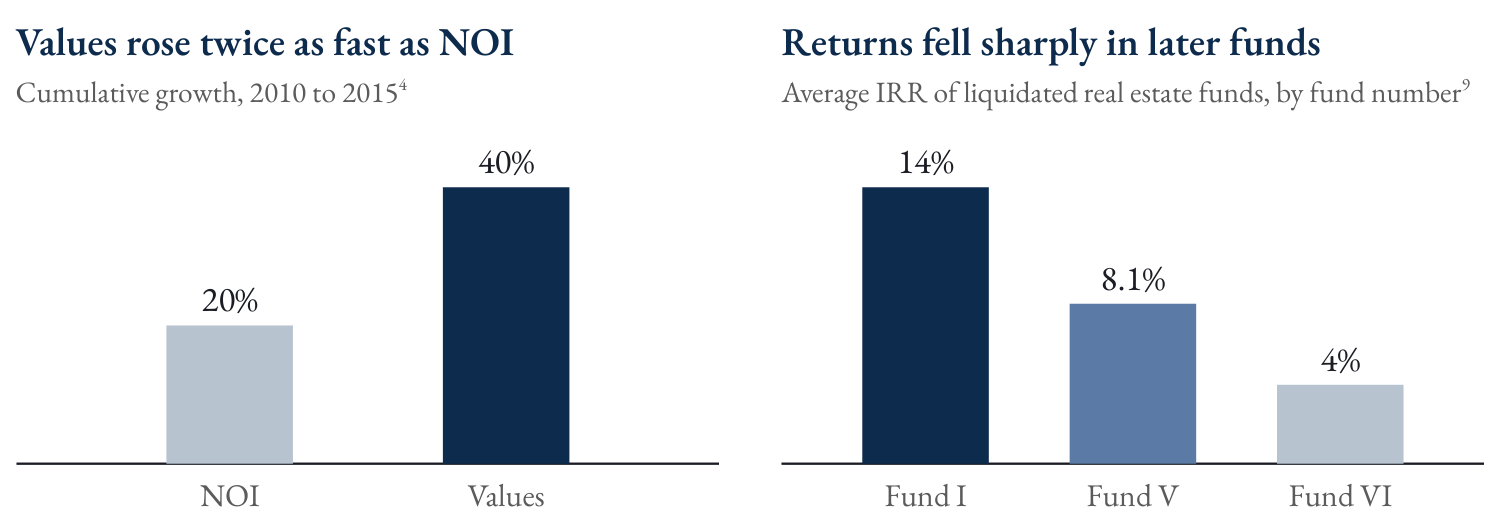
| 1 | Capital markets | Falling rates compressed cap rates by more than 200 bp. From 2010 to 2015, NOI rose ~20% while values rose ~40%.4 |
| 2 | Sector beta | Capital crowded into industrial and multifamily, driving their cap rates down.5 Combined, industrial and residential grew from 36% of core fund holdings in 2015 to about 64% in 2025.6 |
| 3 | Leverage | Cheap debt magnified every gain in value: at 65% loan-to-value, a 10% rise in property value is a 29% gain on equity, before financing costs. |
| 4 | Asset-level performance | Much of the appreciation property owners saw after the financial crisis came from cap rate compression rather than improvements in individual property performance.4 |
The market carried the managers
Research covering 2000 to 2019 finds closed-end real estate funds underperformed listed REITs and performed about the same as core funds (NFI-ODCE), despite more risk.7 Value-add and opportunistic funds earned negative alpha of about 3% a year relative to core from 2000 to 2017, and core funds with moderate added leverage would have matched their risk-adjusted returns.8 Much of what looked like value creation was leverage and market exposure.
Historically, weak asset performance often has not cost a manager its next fund. In one study, average real estate fund IRRs fell from 14% on a manager’s first fund to 4% on its sixth, yet weaker managers kept raising capital.9 With little pressure to measure performance, few firms built the tools to do so.
Appreciation has stalled and business plans now live or die on NOI
Compared with the last cycle, the weakest funds now lose money, cash is not coming back to investors, and new capital is drying up.
| Signal | Then | Now |
|---|---|---|
| Bottom-quartile net IRR3 | 3.4% to 8.0% (2011 to 2014 vintages) | -1.1% and -4.0% (2021 and 2022 vintages) |
| Median DPI10 11 | 0.57x (2018 vintage, at the same age) | 0.24x or less (2019 and later vintages); 0.15x median for 2019 to 2021 |
| Real estate fundraising2 | $198.9B (Jan to Sep 2025) | $136.8B (Jan to Sep 2026), down 31% |
In 2025, core fund values (NFI-ODCE) slipped 0.3% and income produced the entire 3.8% gross return.12 Every point of return now has to come from running assets better.
Funds now face additional pressure to focus on asset-level performance as assets are held longer
Operating partners have always faced scrutiny from the funds they hope to partner with: a weak operator struggles to win its next deal. Funds have not faced the same scrutiny from their own investors. That is changing: performance issues are hurting repeat fundraisers, and the share of institutions planning direct deals, JVs and separate accounts hit five-year highs in 2025.13
Funds
Exits have become less reliable, so funds are holding properties longer and each investment needs more years of active management.14 For 2019 and later vintages, the median fund has returned less than a quarter of investors’ capital,10 and large pensions are pushing managers for standardized, asset-level data.15 The funds that win will track asset-level performance across every operating partner on one basis and give investors that detail.
Operating partners
Large fund managers are building their own operating platforms to rely less on outside partners, while capital concentrates in the largest funds.16 To justify their place and promote, operating partners must prove they drive exceptional asset-level performance.
The last cycle rewarded owning the market. The next one rewards running assets better than the market, and proving it.
About Broome
Broome is an AI-native platform for real estate asset management. Our platform standardizes performance across every asset, so asset managers can see where performance is lagging and catch issues before they spiral.